The short answer to what is the window regulator is this: it is the mechanism that moves your vehicle's side window up and down. It works with the window motor, tracks, cables, clips, and brackets hidden inside the door. When the system is healthy, one switch press creates smooth, controlled glass movement. When it fails, the window can move slowly, tilt forward, drop into the door, or stop halfway during a storm.
The regulator is a small component with an outsized effect on daily driving. A working window controls ventilation, toll-road access, parking-garage tickets, and cabin security. On modern vehicles, it can also interact with one-touch controls, anti-pinch sensors, and automatic window indexing. Here is how the hardware works and what the repair usually involves.
What is the window regulator and how does it work?
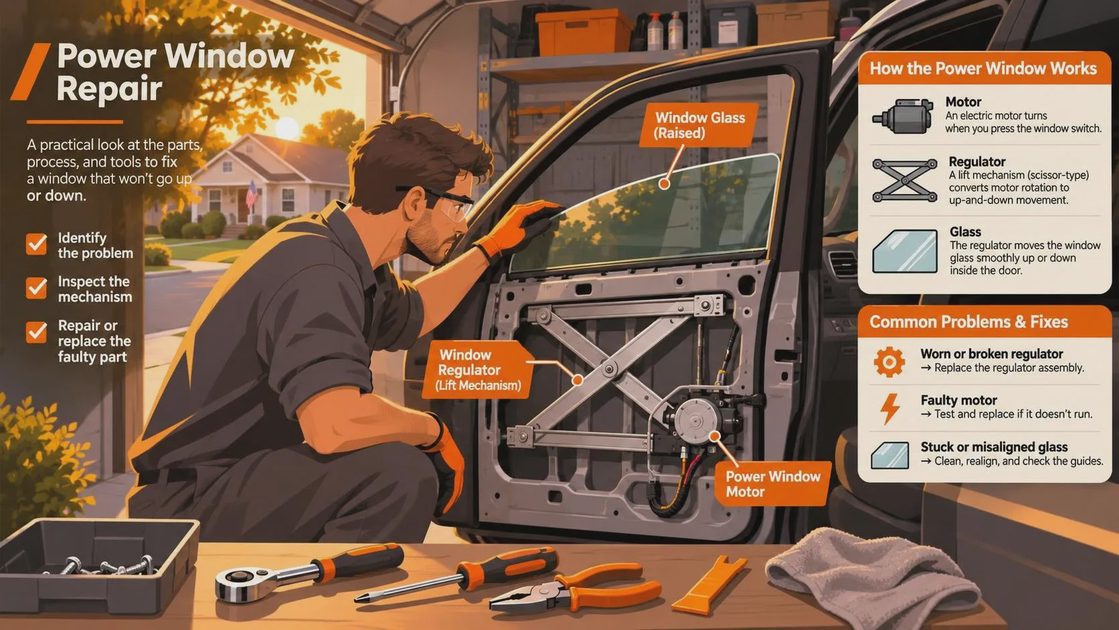
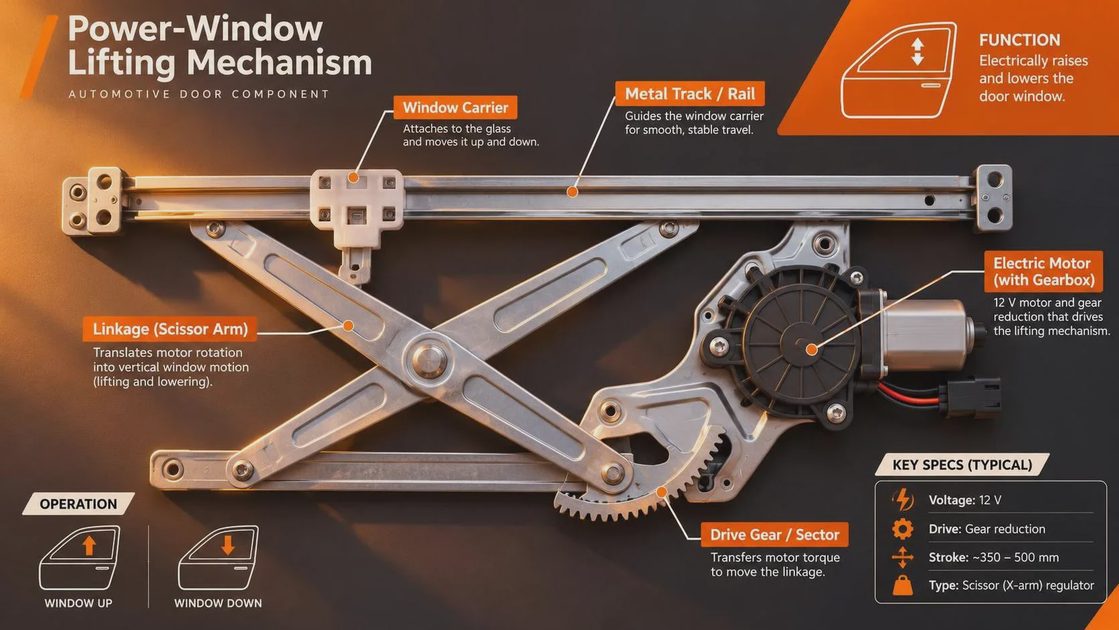
If you are asking what is the window regulator, picture a lifting assembly attached to the glass. In many cars, an electric motor turns a gear that moves a cable, arm, or flexible track. That motion pushes the window carrier upward or pulls it downward. The glass rides in vertical channels lined with guides, which keep it aligned instead of letting it wobble inside the door.
There are three common regulator designs. A cable regulator uses a thin steel cable and pulleys, and it is compact but vulnerable to fraying or tangling. A scissor regulator uses hinged metal arms and is often strong, although its pivot points can wear. A plate or track-style regulator uses a molded carrier sliding along a rail. The motor may be sold separately, but many replacement assemblies include both motor and regulator.
The switch does not usually power the glass directly. It sends a low-voltage signal through wiring and a control circuit to the motor. That is why a window that does not move could have a failed switch, fuse, wiring connection, motor, or regulator. Replacing parts before testing the circuit is how a simple electrical problem becomes an expensive repair.
Signs your window regulator is failing
The most useful clue is the sound. A grinding, clicking, or popping noise from inside the door often points to stripped gears, a loose cable, or a broken pulley. A window that moves at an angle suggests that one guide or lifting point has separated. If the motor runs but the glass stays still, the regulator may have broken while the motor continues spinning.
Another warning sign is inconsistent speed. A window that takes 10 to 15 seconds to close when it previously took about 4 to 8 seconds is showing friction, track contamination, weak motor performance, or a failing mechanism. Those time ranges are practical estimates rather than a universal specification; temperature, glass size, and vehicle design all matter.
A silent window deserves a different diagnosis. Check whether other windows work, whether the window lock button is active, and whether the fuse is intact. If only one window is affected, a local switch, motor, connector, or regulator is more likely than a vehicle-wide power problem. Do not repeatedly hold the switch if the glass is crooked. The motor can overheat, and unsupported glass can fall inside the door.
Diagnosing the problem before paying for parts
Understanding what is the window regulator helps, but diagnosis still requires separating mechanical and electrical symptoms. A technician may remove the door panel, inspect the cable and track, test voltage at the motor connector, and check whether the glass moves freely when disconnected from the assembly. A basic multimeter can show whether the motor receives power when the switch is pressed.
The diagnosis should also include the window channel. Dirt, hardened rubber, and a bent guide can create enough resistance to mimic a bad regulator. Silicone-safe window-track lubricant can help with mild friction, but it cannot repair a broken cable or stripped gear. Avoid spraying random penetrating oil into the channel because it can damage rubber and attract grit.
By the Numbers: an estimated diagnostic visit often takes 30 to 60 minutes, while a straightforward front-door regulator replacement commonly takes 1 to 2.5 labor hours. Rear doors, frameless windows, convertible doors, and vehicles with complex trim can take longer. These are planning ranges, not promises for every model.
Replacement cost and repair choices
The cost of a window regulator depends on the vehicle, door position, part quality, and labor rate. An aftermarket regulator assembly might cost roughly $50 to $180 for a common compact or midsize vehicle. Original-equipment parts can run from about $120 to $400 or more, especially for luxury models, unusual doors, or assemblies that include the motor and control electronics.
Independent-shop labor commonly adds about $100 to $300, depending on local rates and access. A realistic total for many standard cars is approximately $180 to $500. Dealership pricing can be higher, sometimes reaching $600 or more when the original equipment assembly and diagnostic time are included. Ask whether the quote covers clips, a new vapor barrier seal, installation, testing, and warranty coverage.
If the motor works and the regulator alone is damaged, replacing only the mechanism can reduce parts cost. However, a combined motor-and-regulator assembly may be better value when the motor is old, noisy, or difficult to access. The best choice is not automatically the cheapest part. A low-priced assembly that fails again after six months can cost more than a better-supported part with a one-year warranty.
Can you replace a window regulator yourself?
For an experienced home mechanic, the job can be manageable. The typical sequence is to disconnect the battery when required by the vehicle service procedure, remove the door trim, support the glass, disconnect the motor, unbolt the old regulator, transfer the glass if necessary, and test the window before reinstalling the panel. Some doors use sharp stamped metal, exposed airbag wiring, or tight plastic clips, so protective gloves and careful labeling matter.
The glass must be supported before the regulator is removed. A temporary brace, suction cup tool, or properly placed tape can prevent it from dropping. Never rely on tape alone if the glass is heavy or the door is being moved. After installation, check full travel, alignment, one-touch operation, anti-pinch behavior, and unusual noise.
A shop is the smarter option if the window is shattered, the door contains a side-impact airbag, the glass is trapped at an angle, or the vehicle uses complicated frameless glass calibration. Labor savings of $100 to $300 are not worth creating a water leak or damaging a safety component.
Buying a used car with window problems
If a seller says the window only needs a switch, test it repeatedly from the driver's controls and the individual door switch. Listen while holding the glass at several positions. A seller's explanation is not a diagnosis. A nonworking window can be a $40 switch, a $200 regulator, or a larger wiring issue.
Use the symptom to negotiate, but price the repair conservatively. For example, a $300 estimated repair should be treated as $400 in a purchase budget because broken clips, trim damage, or a second worn component can appear during disassembly. Check for moisture stains on the door panel and carpet as well. A window that does not seal can allow rain into the cabin and create electrical or mold problems.
Final take: fix the right component
Now that you know what is the window regulator, the key lesson is simple: the regulator is the lifting hardware, not the entire power-window system. A grinding sound, crooked glass, or motor that spins without movement points toward the mechanism, while silence requires electrical testing first. Get a written diagnosis, compare an aftermarket and original-equipment quote, and confirm the warranty before authorizing work.
For many common vehicles, this is a routine repair rather than a reason to replace the car. The right diagnosis keeps a modest door repair from becoming an unnecessary parts-shopping exercise.
No comments yet.