A police written warning ticket is usually less serious than a moving violation, but it is not automatically invisible to your auto insurer. The practical answer depends on what the officer recorded, whether the warning enters a state or local database, and how your insurance company reviews driver information. If you received one, do not assume your premium will jump, but do not ignore the paperwork either.
I separate this question into two data points: whether the warning creates a conviction or insurance point, and whether an insurer can see it during underwriting or a policy review. Those are different events. A written warning often does not carry a fine, court date, or points. However, reporting practices vary by jurisdiction, department, and violation type.
What a police written warning ticket actually means
A written warning is an official notice that an officer observed a traffic issue, such as speeding below the citation threshold, an unsafe lane change, a broken taillight, or a failure to signal. The officer documents the event and gives the driver instructions, but generally does not issue a payable citation. In ordinary conversation, people call this a police written warning ticket even though the document may not legally be a ticket.
That distinction matters. A citation normally creates a court or payment record. A warning may remain only in the law enforcement agency's system. Some agencies share warning data with a state department of motor vehicles, while others keep it for internal use. A warning also does not normally add license points by itself, although local rules control.
The document should tell you what happened next. Look for language such as “warning,” “no fine,” “no court appearance,” or “informational notice.” If it lists a violation code, date, plate number, and driver's license number, keep a photo for your records. If it says you must repair equipment or provide proof, complete that step quickly.
By the Numbers
For a useful risk screen, track four items: the violation type, whether points were assigned, whether a fine was imposed, and whether the event appears on your motor vehicle record. A clean record with one equipment warning is a very different underwriting profile from multiple speed-related citations, even if the paperwork looks similar.
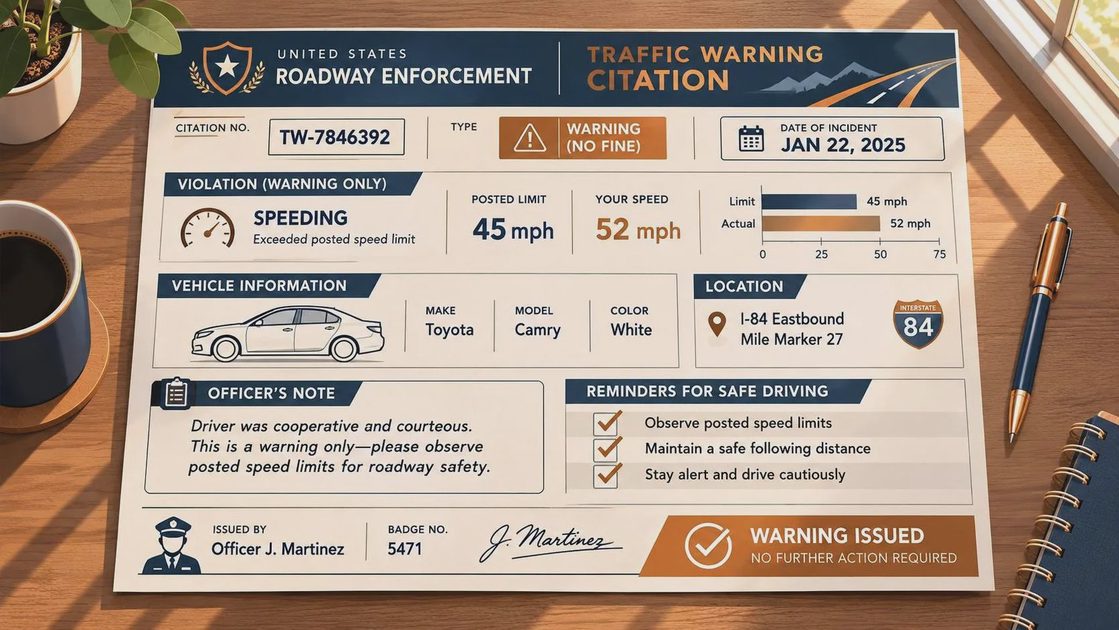
Can a police written warning ticket increase car insurance?
In many cases, a police written warning ticket does not directly raise rates because it is not a conviction and does not add points. Insurers commonly price policies using driving history, claims, vehicle characteristics, location, coverage limits, credit-based insurance information where permitted, and other approved rating factors. A nonpoint warning is usually less important than a ticket that results in a conviction.
Still, “usually” is not the same as “never.” An insurer could see a warning if it is included in a motor vehicle report, obtained through an approved data service, or disclosed during an application. A company might also treat repeated warnings as a sign of risk during a broader underwriting review, especially when they appear alongside crashes or recent violations.
The financial difference can be meaningful. A minor moving violation might add roughly $15 to $60 per month at renewal for some drivers, based on an illustrative estimate rather than a universal rate. A written warning often adds $0. The larger risk is a pattern: two or three documented driving events can trigger a closer review even when the first event had no immediate premium effect.
Do not cancel coverage or switch cars to hide the issue. A lapse in insurance can create larger costs than a warning, including higher future premiums and legal problems after a crash.
What insurers can see during a record check
A police written warning ticket may be visible in one system but absent from another. Insurers typically focus on reportable violations and convictions when ordering motor vehicle records. Those records can show the offense date, disposition, points, license status, and sometimes accident information. A local warning database is not necessarily part of the state record an insurer receives.
Ask your state's motor vehicle agency for a certified driving record if you want a definitive answer. Online records often cost about $5 to $25, depending on the state and record type. Compare the record with your warning paperwork. If the event is missing, that does not prove no database contains it, but it does indicate the warning is less likely to affect standard rating.
When applying for a new policy, answer questions exactly as written. If the form asks about convictions or tickets, a warning may not fit that definition. If it asks about all traffic stops or violations, disclose it. Misstating an application can create a bigger problem than the original police written warning ticket.
What to do after receiving a warning
Start by reading every line, including the back. Confirm whether the officer requires a repair, proof of insurance, a signature, or a response by a specific date. A warning for an expired registration or defective lamp can often be resolved by correcting the issue and retaining the receipt, inspection record, or repair invoice.
Next, check your driving record after enough time has passed for local processing. If the warning is listed incorrectly as a conviction, contact the issuing court or agency and ask how to correct the record. Keep copies of the warning, correspondence, and any confirmation number. A clean paper trail is useful if an insurer later asks questions.
Then review your policy's renewal date and current premium. Do not make a coverage change solely because you fear a warning. Instead, compare the declarations page with fresh quotes from several carriers. Progressive, GEICO, State Farm, and regional insurers use different underwriting models, so one company can weigh a recent record differently from another.
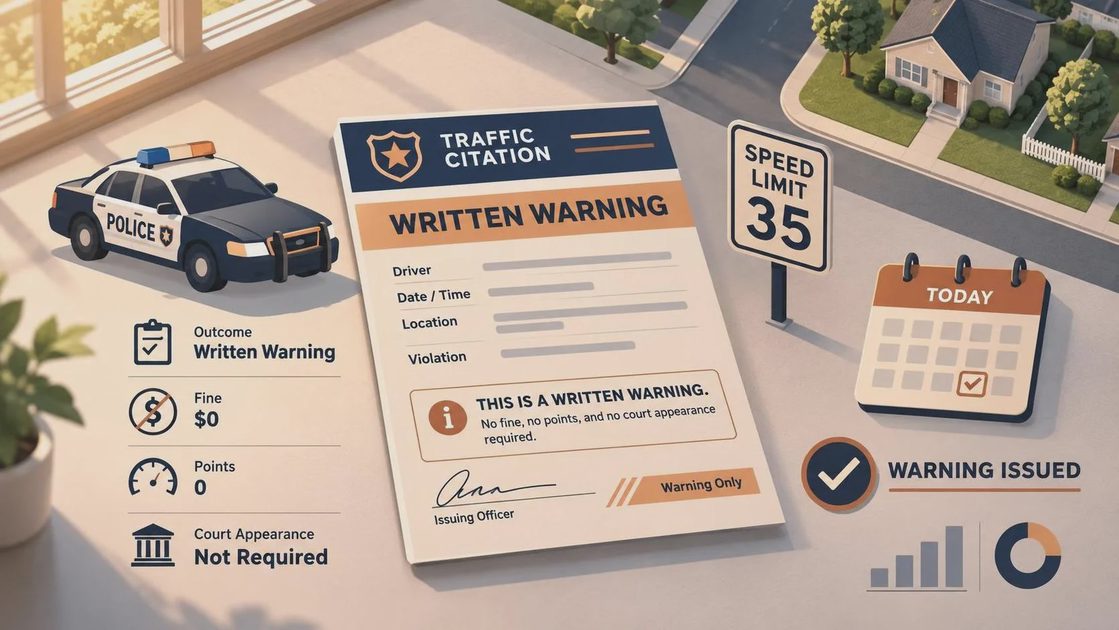
How to protect your premium
The best response to a police written warning ticket is boring but effective: prevent the next event. Set a speed alert in your vehicle, use adaptive cruise control appropriately, replace worn bulbs immediately, and schedule registration or inspection reminders. These actions cost little compared with a collision claim or a sustained surcharge.
Review your deductible and liability limits before shopping for a lower payment. Raising a collision deductible from $500 to $1,000 can reduce premium in some cases, but it also means finding an additional $500 after a covered crash. Cutting liability limits is usually a poor trade for a small monthly savings, particularly for drivers with significant assets or a long commute.
Ask whether your insurer offers a telematics program, defensive-driving discount, or accident-free discount. Telematics can measure braking, mileage, acceleration, and time of day; the program may help a careful driver, but privacy and rate rules differ. Get the program terms in writing before enrolling.
The bottom line for drivers
A police written warning ticket is generally a warning, not a premium sentence. One nonpoint equipment or minor traffic warning often produces no rate change, while a conviction, repeated incidents, or a crash can affect pricing much more. The only reliable way to assess exposure is to verify the violation status, check your motor vehicle record, and review your insurer's renewal documents.
If your renewal increases, request the rating explanation and shop comparable quotes with the same liability limits, deductibles, collision coverage, and comprehensive coverage. Compare the total six-month or annual premium, not just a teaser monthly figure. That spreadsheet approach turns an uncertain stop into a measurable insurance decision—and keeps a single police written warning ticket from becoming an expensive guessing game.
No comments yet.