A $35,000 car can cost thousands more before you drive it home. So what is an out the door price? It’s the total purchase price of the vehicle, including the agreed vehicle price, applicable taxes, government charges, and dealer fees or add-ons. Ask for that number in writing before comparing offers. It’s the number they’re showing versus the number that matters.
What is an out the door price made of?
Think of the out-the-door price as a receipt for the purchase, not a monthly payment. A useful quote separates each charge so you can see what’s mandatory, what’s negotiable, and what you never agreed to buy.
The starting point is the negotiated selling price of the vehicle. For a new car, check whether the advertised price already includes the manufacturer’s destination charge. It’s often included in the window sticker price, but an ad may present numbers differently. Don’t let it appear twice.
Next come sales tax and government charges, such as title and registration. The amounts depend on where the vehicle will be registered and the details of the transaction. A dealer may collect estimated government charges and reconcile them later, so ask how an overpayment or shortfall is handled.
Dealer fees are another line item. A documentation or processing fee may be listed separately from the vehicle price. Rules and amounts vary by state and dealer; even if a dealer won’t reduce its fee, you can negotiate the overall price. Optional products, such as paint protection, accessories, service contracts, or maintenance plans, should also be itemized rather than buried in a lump sum.
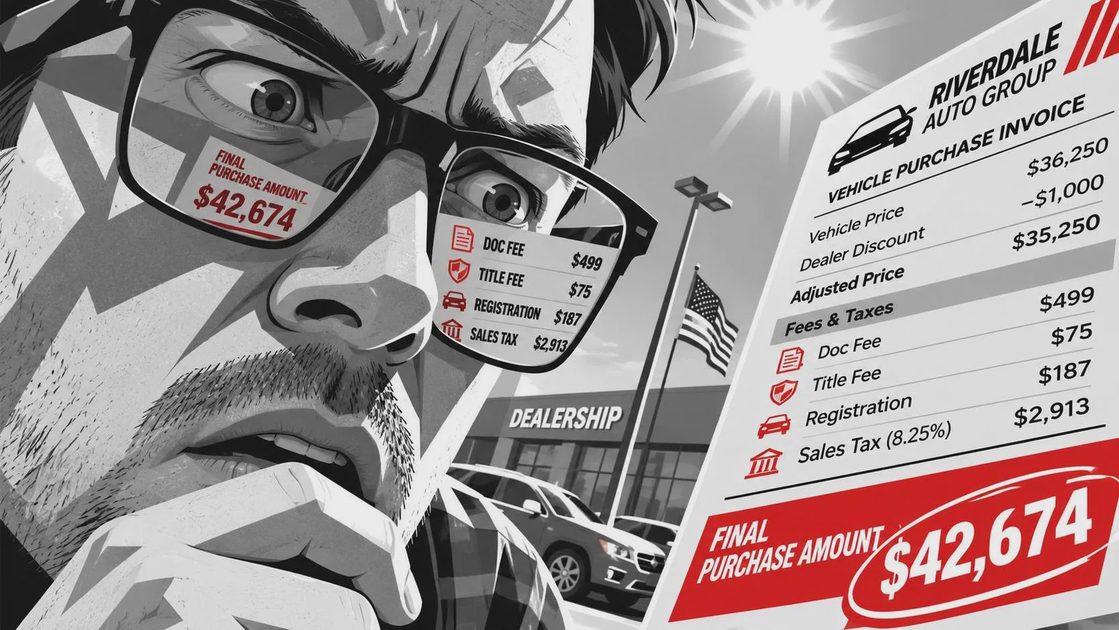
By the Numbers: a sample purchase
Here’s an illustrative cash-price calculation, not a quote or a tax estimate for a particular state:
The agreed vehicle price is $35,000. Add $2,100 in hypothetical sales tax, $400 in title and registration charges, and a $500 dealer documentation fee. With no add-ons, the out-the-door price is $38,000. That’s $3,000, or about 8.6%, above the vehicle price.
If the dealer adds a $1,200 protection package and the assumed tax stays unchanged, the total rises to $39,200. In a real transaction, tax on an add-on may change the calculation, so request a revised itemized quote rather than simply adding its sticker price.
This example shows why a lower advertised price isn’t automatically the better deal. A second dealer offering the same vehicle for $35,500 but charging $300 less in combined fees would still need a full tax and registration calculation before you could compare the two offers fairly.
What the number does and doesn’t include
An out-the-door quote normally describes the purchase before loan interest. It is not the total cost of financing, and the term alone doesn’t guarantee every lender charge has been included. Ask whether any loan origination fee or other finance charge is part of the quoted amount or will be added separately.
A down payment also doesn’t reduce the vehicle’s purchase price. It reduces the amount you need to finance or otherwise pay at closing. For example, on a $38,000 purchase, a $5,000 down payment leaves $33,000 to cover before considering any additional financing charges or trade-in adjustments.
A trade-in is separate math, too. Its agreed value can reduce what you owe, but an outstanding loan on that vehicle must be paid off. If the payoff exceeds the trade-in value, the difference is negative equity; rolling it into the new loan increases the amount financed. Tax treatment of trade-ins varies by state, so don’t assume the same tax savings everywhere.
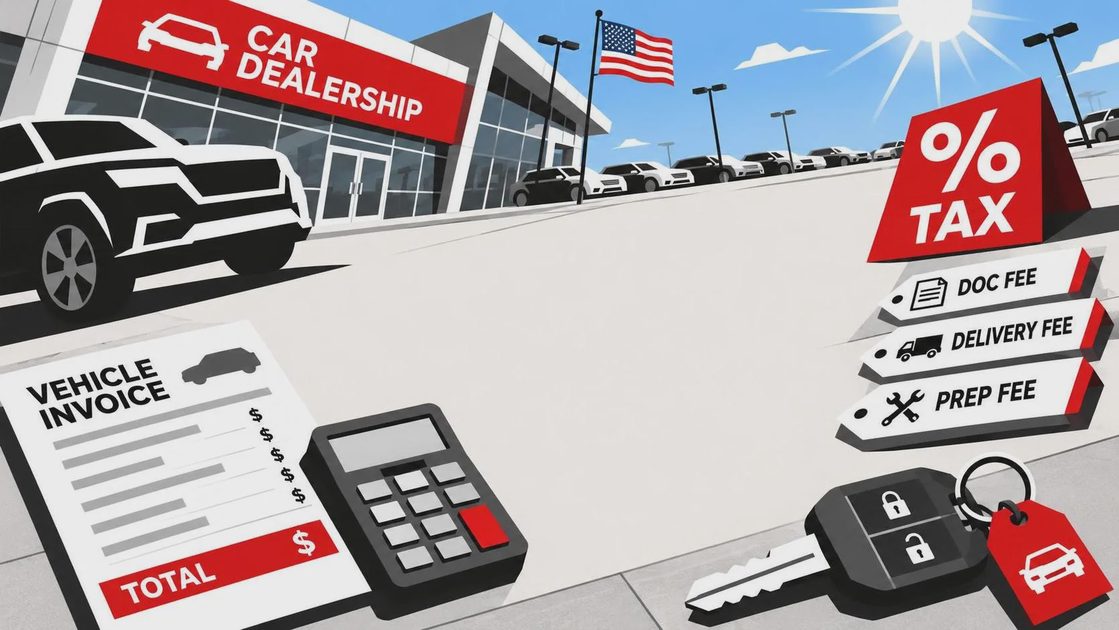
How to request a quote you can compare
Send each dealer the same request: an itemized out-the-door quote for the specific vehicle, including its vehicle identification number, your registration ZIP code, all required fees, and any installed accessories. Ask whether the quote assumes financing through the dealer, a trade-in, or eligibility for a particular rebate.
Compare the same car configuration and the same purchase assumptions. A quote that requires a trade-in or a restricted incentive is not directly comparable to one available without those conditions. If an advertised discount depends on financing, ask for both the cash price and the financed offer, then compare the financing costs separately.
For an EV, ask the dealer to identify any incentive as a separate line and explain whether it is actually applied at the point of sale. Eligibility and available programs can change; don’t subtract a potential credit from your budget unless you have confirmed the relevant rules and your eligibility. Charging equipment and installation are ownership costs, not automatically part of the vehicle purchase quote.
Check the paperwork before signing
Match the purchase agreement against the written quote line by line. Look especially for accessories, protection packages, service contracts, and fees that appeared after the initial offer. If you don’t want an optional product, ask for it to be removed and for a corrected total before signing.
Then review the finance agreement separately. Check the amount financed, annual percentage rate, term, monthly payment, and total of payments. A longer loan can lower the monthly figure while increasing total interest; a low payment by itself tells you very little about the deal.
My spreadsheet rule is simple: put the purchase price, trade-in and payoff, down payment, and financing costs in separate cells. That makes it much harder for a change in one number to disguise a worse deal somewhere else.
No comments yet.