The sticker price is not the number to shop by. The out the door price meaning is the total amount required to purchase a car after the vehicle price, applicable taxes, government charges, and dealer fees or add-ons are included. It’s the number to get in writing before discussing a monthly payment. Your down payment or trade-in may reduce what you still owe, but neither makes the car itself cheaper.
What goes into an out-the-door quote?
Start with the negotiated selling price of the vehicle, then add the charges needed to complete the purchase. A useful quote separates each line instead of burying everything in a single total.
Sales tax depends on where the vehicle will be registered and the rules that apply there. Title, registration, and plate charges also vary by location and transaction. A dealer may estimate these amounts initially and adjust them when the paperwork is finalized.
Dealer documentation or processing fees are different: They’re charged by the dealer, even when state law limits or regulates them. Ask whether an advertised price already includes the fee. If it doesn’t, add it before comparing offers. A lower vehicle price can easily be offset by a higher dealer fee.
Also look for accessories, protection packages, warranties, and other products. Some are optional; others may already be installed or presented as part of the deal. Ask for the price with each item removed. If the dealer won’t remove one, compare the full package with competing offers rather than assuming the add-on is free.
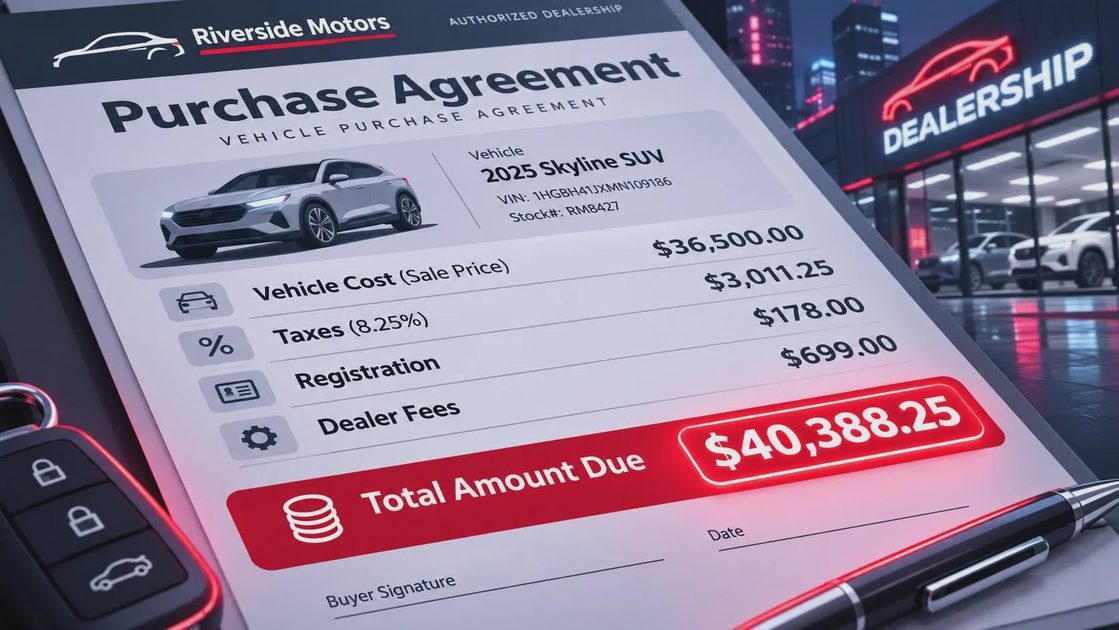
Out the door price meaning: a worked example
By the Numbers: The following figures are illustrative, not a quote or a prediction of local charges. Assume the sales tax is calculated on the full selling price in this simplified example.
Vehicle selling price: $30,000. Sales tax at an assumed 6%: $1,800. Title and registration: $300. Dealer documentation fee: $500. Optional add-ons: $0.
That produces an out-the-door price of $32,600. The gap from the advertised vehicle price is $2,600, or about 8.7%. If a dealer adds a $1,000 protection package and the example tax applies to it, the total rises to $33,660. Actual tax treatment varies by jurisdiction and by product.
Now suppose you put $5,000 down with no trade-in. Using the original $32,600 total, you would finance $27,600 before any separately financed products or lender charges. The down payment changes the amount borrowed, not the purchase price. And $27,600 is not the total you’ll ultimately pay on a loan: Interest adds to the cost over time.
Trade-ins and incentives: keep the math visible
A trade-in is useful leverage only when you can see its value separately from the new car’s price. Ask the dealer to show the purchase price, trade-in allowance, any trade-in loan payoff, and the resulting balance on separate lines.
If your trade-in is worth $12,000 and you owe $9,000, you have $3,000 in equity before any transaction-specific adjustments. If you owe $14,000 instead, you have $2,000 in negative equity. Rolling that shortfall into a new loan increases the amount financed; it does not reduce the new car’s price.
Some states provide a sales-tax benefit for a qualifying trade-in, but the rules differ. Ask the dealer to show how the tax was calculated rather than assuming the allowance reduces your taxable amount everywhere.
Rebates and EV incentives deserve the same scrutiny. A quote may assume financing through a particular lender, a qualifying trade-in, or eligibility for an incentive. Ask which discounts are already included and what documentation is required. Do not subtract an incentive twice, and don’t treat a potential future tax benefit as cash off today’s deal unless it is actually applied at purchase.

Why the monthly payment can mislead
The number they’re showing versus the number that matters: A monthly payment describes the loan schedule; the out-the-door figure describes the transaction. A longer loan can lower the monthly payment while increasing total interest. It can also leave you owing more than the vehicle is worth for longer.
Compare financing offers using the amount financed, annual percentage rate, loan term, payment, and total of payments. The APR reflects the cost of credit, including interest and certain finance charges; it is not the same thing as the car’s purchase price. Ask for the loan disclosure and check which charges are financed.
For a clean comparison, keep the down payment, trade-in assumptions, and loan term consistent. Then compare the out-the-door prices separately from the financing. A great rate cannot rescue a deal loaded with expensive products you didn’t want.
Get a quote you can actually compare
Send each dealer the same request: “Please provide an itemized out-the-door quote for this specific vehicle, including the selling price, all dealer fees and add-ons, estimated taxes, title, registration, and any conditions on discounts.” Include your registration ZIP code and ask for the vehicle identification number so you know the quotes cover comparable cars.
Request the purchase price before adding a trade-in or down payment. If you’re financing, get a separate breakdown of the amount financed and loan terms. For a lease, ask for a lease-specific breakdown instead: The amount due at signing and total lease payments are not the same as the purchase price.
Finally, check the buyer’s order against the quote before signing. Watch for changed fees, added products, and discounts that disappeared. If a charge is unclear, ask for its name, amount, and whether it is required. The best deal is the one whose complete math still works when it reaches the paperwork.
No comments yet.