The useful clock on gasoline is measured in months, not years. If you're asking how long is gas good for, a practical rule of thumb is about three to six months for untreated gasoline stored properly. Fuel stabilizer can extend that window, but it doesn't make gasoline last forever or restore fuel that's already degraded. Heat, air exposure, ethanol content, and the container all change the answer.
For a car that's been parked for a few weeks, old gas usually isn't the first thing I'd worry about. For a vehicle or gas can sitting through a hot summer and beyond, start paying attention to fuel age and storage conditions before turning the key or pouring it into a tank.
How long is gas good for in a car or gas can?
By the Numbers: Three to six months is a planning estimate for untreated gasoline, not an expiration date stamped on every gallon. Gas can degrade sooner in heat or with significant exposure to air. Cooler, properly sealed storage can slow that process. You also don't know exactly how long the fuel sat before you bought it, so the fill-up date is a useful approximation, not a lab measurement.
A modern car's fuel system is more enclosed than an open container, but that doesn't stop fuel from aging. A partly filled tank leaves more air space, and temperature changes can encourage moisture accumulation. Follow the owner's manual for storage instructions; some manufacturers recommend filling the tank and adding a stabilizer before a long layup.
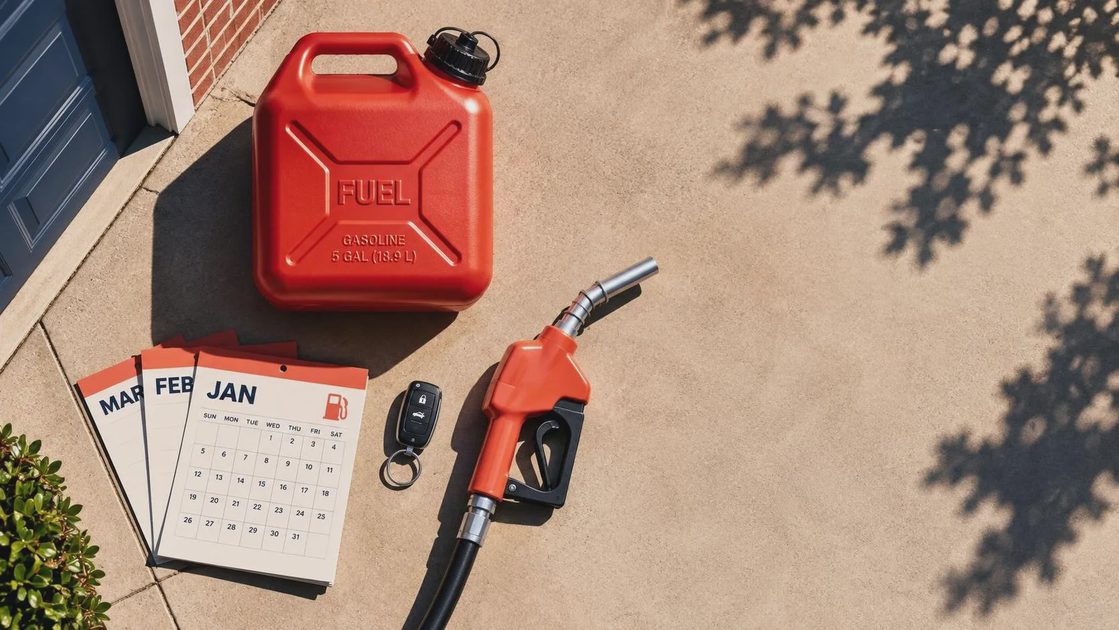
For a portable can, use a container approved for gasoline, close it tightly, and store it in a cool, well-ventilated location away from living spaces, ignition sources, and direct sunlight. Don't put it in a basement or an attached living area. Local fire codes can limit where and how much fuel you may store.
What makes gasoline go bad?
Gasoline is a blend of compounds, and some of its more volatile components evaporate over time. Oxygen can also react with the fuel, forming gums and deposits. The result can be harder starting, rough operation, or deposits in fuel-system components. Those symptoms have other possible causes, so they're not proof that gasoline is bad.
Ethanol adds another variable. Many gasoline blends contain ethanol, which can absorb moisture. If enough water accumulates, an ethanol-and-water layer can separate from the gasoline. That is called phase separation, and shaking the container or adding ordinary fuel stabilizer is not a reliable fix.
Ethanol-free gasoline can avoid that particular water-related problem, but it still oxidizes and loses volatile components. It is not a license to store fuel indefinitely. Likewise, premium gasoline is not automatically a better storage choice: its octane rating describes knock resistance, not a guaranteed shelf life.
The number on your calendar matters less than the conditions behind it. Six months in a tightly closed, appropriate container kept cool is a different situation from six months in a vented or poorly sealed container exposed to heat. Treat the timeline as a risk gauge, not a pass-or-fail test.
How to judge old fuel without taking chances
Start with the history: when was the fuel purchased, where was it stored, and was stabilizer added while it was fresh? If you can't answer those questions and the fuel may be years old, don't assume it's safe to use just because the container was closed.
Visible cloudiness, sediment, a separate layer, or a darkened appearance can indicate a problem. A sour or varnish-like odor can also be a warning, but don't deliberately sniff gasoline: its vapors are hazardous. Appearance alone can't establish that fuel is good, either. Gasoline can look normal and still have lost useful volatility.
If the fuel is visibly contaminated or separated, leave it in its approved container and arrange disposal. Don't pour it through a household filter and call the job done. Filtering may remove some particles, but it won't reliably repair degraded fuel or resolve water contamination.
If old fuel is already in a vehicle and the engine runs poorly, avoid repeated starting attempts. A mechanic can assess whether the tank needs to be drained and whether fuel-system components have been affected. If the engine won't start, don't assume the gas is the only culprit: a discharged 12-volt battery is another common issue after storage.
For a small amount of moderately aged fuel that shows no visible contamination, the right decision depends on its history and the vehicle. Ask a qualified mechanic before mixing it with fresh gas. Never dilute visibly separated or contaminated fuel into a vehicle tank as a workaround.
Does fuel stabilizer extend the storage window?
Yes, when used as directed in fresh gasoline. Stabilizer slows some of the chemical changes that degrade fuel; the useful storage period depends on the product, dose, fuel, and conditions. Some products claim protection for a year or longer, but that is a manufacturer claim under stated conditions, not a guarantee for every tank.
Add the recommended amount before storage, then follow the product and vehicle instructions for circulating treated fuel through the system. Don't overdose on the theory that more is better. For an already-stored vehicle, adding stabilizer months later won't reverse degradation that has already happened.
For a plug-in hybrid that burns gas infrequently, check the owner's manual for fuel-aging and storage guidance. Some vehicles manage engine operation to help use aging fuel, but the details vary. Don't assume an EV-heavy commute means the gasoline tank needs no attention.
Where to dispose of old gasoline
Contact your local household hazardous-waste program or municipal waste department for an accepted drop-off location and instructions. Some facilities have limits on container size or require appointments. Keep the fuel in an approved, sealed container during transport and follow the facility's directions.
Never pour gasoline onto the ground, into a storm drain, down a sink, or into the trash. Don't burn it to get rid of it. The small inconvenience of a disposal trip beats contaminating water, damaging a fuel system, or creating a fire hazard.
My practical cutoff is simple: label the can with the purchase date, use stored fuel promptly, and make a storage plan before the vehicle sits for months. If the fuel's history is a mystery or it shows signs of contamination, professional assessment or proper disposal is the smarter calculation.
No comments yet.