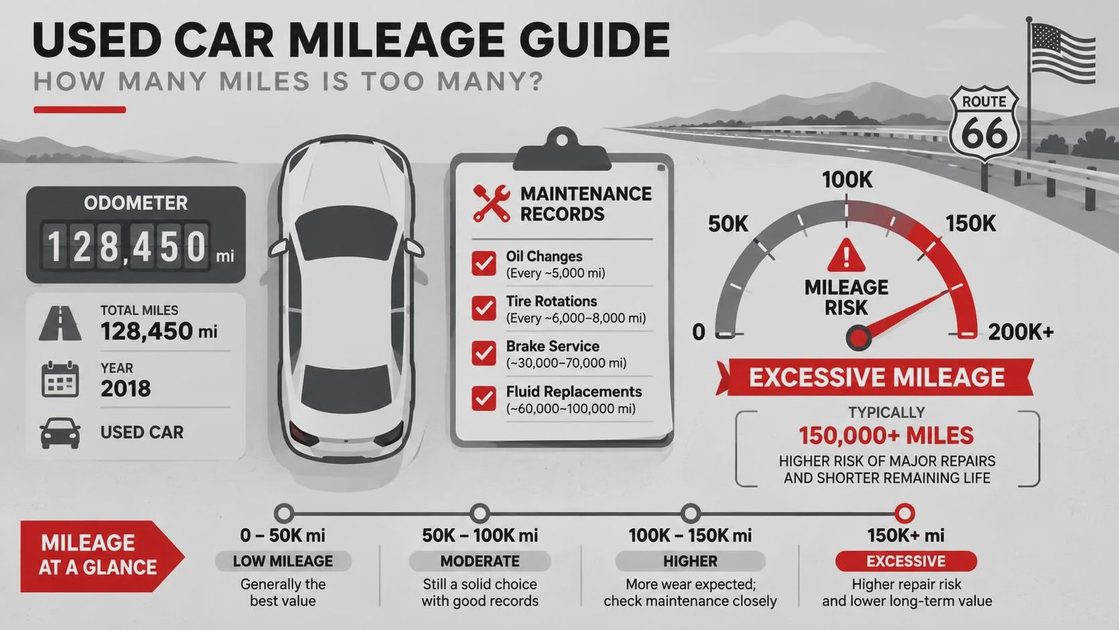
A six-figure odometer reading is not an automatic deal breaker. If you're asking how much is too many miles on a used car, treat 100,000 miles as the point to scrutinize maintenance and future repairs more closely, not as an expiration date. At 150,000 miles or more, the purchase can still make sense, but only if the price, documented history, and independent inspection leave room for greater repair risk.
My take: a well-maintained 120,000-mile car can be a better buy than a neglected 70,000-mile example. The number on the dashboard tells you how far the car has traveled. It doesn't tell you whether anyone changed the fluids, fixed leaks, or ignored a warning light.
By the Numbers: Put mileage in context
Start by dividing the odometer reading by the car's approximate age. A six-year-old car with 72,000 miles works out to 12,000 miles a year. That's a useful comparison point, not a pass-or-fail standard. A car with fewer annual miles isn't automatically healthier, and a car with more isn't automatically worn out.
Under 60,000 miles, focus on age as well as distance. Tires, rubber seals, fluids, and the 12-volt battery can deteriorate even when a vehicle sits. Look for evidence of regular servicing rather than assuming low miles mean low costs.
From 60,000 to 100,000 miles, check the manufacturer's maintenance schedule against receipts. Depending on the vehicle, larger scheduled items may be approaching. Don't assume a seller's recent oil change covers them.
Above 100,000 miles, investigate the expensive systems more carefully: engine or drive unit, transmission, cooling system, suspension, and any model-specific scheduled service. Above 150,000 miles, budget uncertainty matters even more. These are shopping checkpoints, not failure predictions.
How much is too many miles on a used car with no records?
Missing records don't prove neglect, but they transfer uncertainty to you. Ask for dated invoices with mileage, not just a seller's assurance that the car was maintained. A vehicle-history report can help identify reported events, but it may not capture every repair, collision, or service visit.
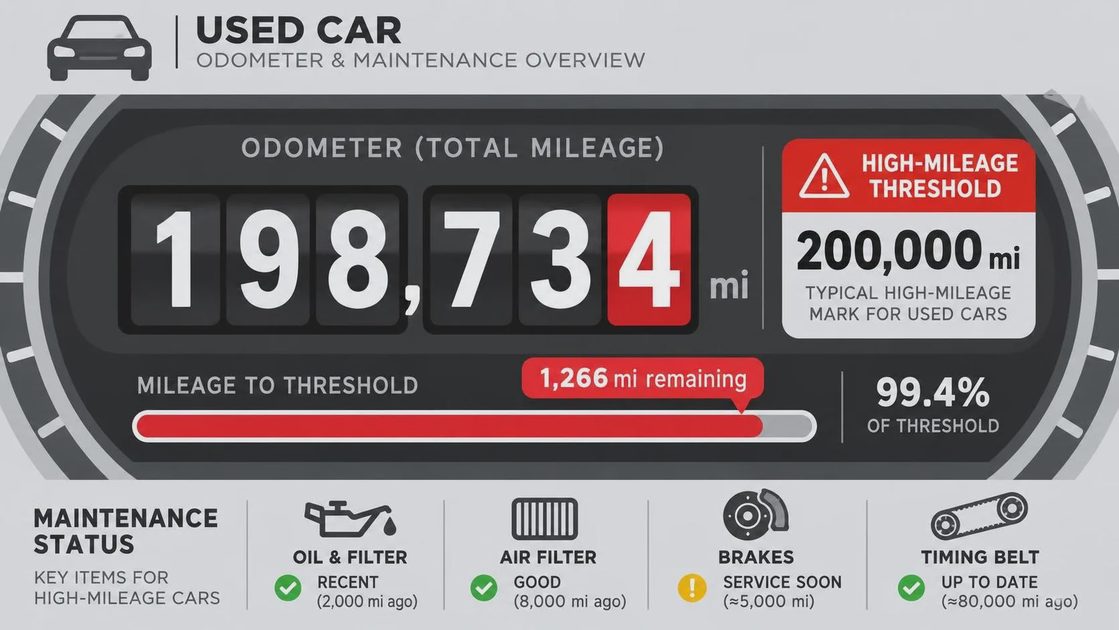
Compare the receipts with the maintenance schedule for that exact model, engine, and model year. Check whether intervals are based on mileage, time, or both. A timing belt, where fitted, is a particularly important example: replacement can be a substantial expense, and an overdue belt may create serious engine risk. Don't assume every car has one; some use a timing chain instead.
Also look for gaps or inconsistent odometer readings across inspection records, service invoices, and title paperwork. An unexplained discrepancy deserves a clear answer before you spend money on an inspection. If the seller cannot explain it, walking away is reasonable.
Highway miles versus city miles
The number they're showing versus the number that matters: 90,000 highway miles and 90,000 stop-and-go miles put different demands on a vehicle. Frequent short trips may mean more cold starts; dense traffic adds braking, shifting, and idling. Highway driving can still bring its own wear, including tire damage and paint chips.
You usually can't verify every mile's origin, so treat the seller's driving story as context, not proof. Instead, look for observable clues: uneven tire wear, worn suspension components, fluid leaks, and corrosion underneath. A car from a road-salt region may have rust concerns that its mileage alone won't reveal.
On the test drive, start with a cold engine if possible. Listen for unusual noises, check for warning lights, and notice whether the car tracks straight and brakes smoothly. A quiet drive is encouraging, but it cannot replace a lift inspection or a diagnostic scan.
What changes when the used car is an EV?
Mileage still matters for tires, suspension, brakes, and cabin wear, but battery condition adds another variable. Ask for a battery health report or diagnostic assessment that states the method used. A dashboard range estimate by itself is not a battery health test: temperature, speed, climate settings, and recent driving can change the displayed number.
Review the remaining battery warranty using the vehicle's original in-service date, mileage, and applicable warranty terms. Coverage can have time and mileage limits, and capacity-loss coverage may have a specific threshold and exclusions. Confirm transferability and eligibility with the manufacturer or an authorized service center using the VIN.
Charging history can be useful context, but don't reject a car solely because it used DC fast charging. Prioritize a documented battery assessment, any outstanding recalls, and an inspection by a shop familiar with that model. Also verify that the charging equipment included in the deal works with your intended setup.
Turn mileage risk into a purchase price
Before making an offer, compare similar vehicles by model year, trim, mileage, condition, location, and title status. Then build a simple first-year budget: purchase price plus taxes and fees, immediate maintenance, insurance, and an estimated repair reserve. The reserve is your planning assumption, not a quote; ask a qualified shop for estimates on identified work.
For example, if one car costs $2,000 less but needs $1,500 in documented repairs, its initial advantage is only $500 before accounting for any other differences. If the repair estimate is uncertain, a small discount may not justify the risk. A clean title is important, but it isn't proof that the car has never been damaged.
Pay for a pre-purchase inspection at a shop independent of the seller. Ask for a written estimate of urgent repairs and upcoming maintenance, then use those numbers to negotiate. If the seller won't permit an independent inspection, I'd move on. The right mileage ceiling is the one your inspection, budget, and tolerance for downtime can support.
No comments yet.