If you have searched whats transmission in a car, you are asking about one of the vehicle's most important mechanical systems. The transmission transfers engine power to the wheels while keeping the engine operating within a usable speed range. Without it, an internal-combustion car would struggle to start, accelerate, or cruise efficiently. The basic concept is straightforward, but transmission type affects fuel economy, acceleration, repair bills, driving feel, and sometimes insurance costs.
Think of the transmission as a controlled set of gears between the engine and the wheels. A low gear multiplies torque for starting or climbing. A higher gear reduces engine speed during highway travel. The system changes ratios as speed and load change, either automatically through computer-controlled hydraulics or manually through a clutch and gear selector.
Whats transmission in a car: the main types
The most common design in the United States is the automatic transmission. Traditional automatics use planetary gearsets, fluid, a torque converter, and electronic controls. Current gas-powered vehicles commonly have six, eight, or ten forward speeds. More ratios can help an engine stay near its efficient operating range, although added hardware can increase complexity.
A manual transmission uses a clutch pedal and a gear lever. The driver selects the ratio and controls the clutch when starting or shifting. Manuals can be durable and relatively inexpensive to service, but they require more attention in stop-and-go traffic. They are also less common in new vehicles, which limits selection and can affect resale demand.
Continuously variable transmissions, or CVTs, use pulleys and a belt or chain rather than fixed gear steps. The goal is to keep the engine at an efficient speed. A CVT can improve city fuel economy, but its constant engine note feels unusual to drivers accustomed to traditional shifting. Nissan, Subaru, Toyota, and Honda have used different CVT designs, so reliability should be evaluated by specific model and service history rather than by the label alone.
Dual-clutch transmissions use two clutches to preselect the next gear. They can deliver quick shifts and strong efficiency, but low-speed behavior varies widely. Some feel smooth; others can feel abrupt when parking or creeping through traffic. This is why a test drive should include a garage ramp, a crowded intersection, and highway merging rather than only a quick loop around a dealership.
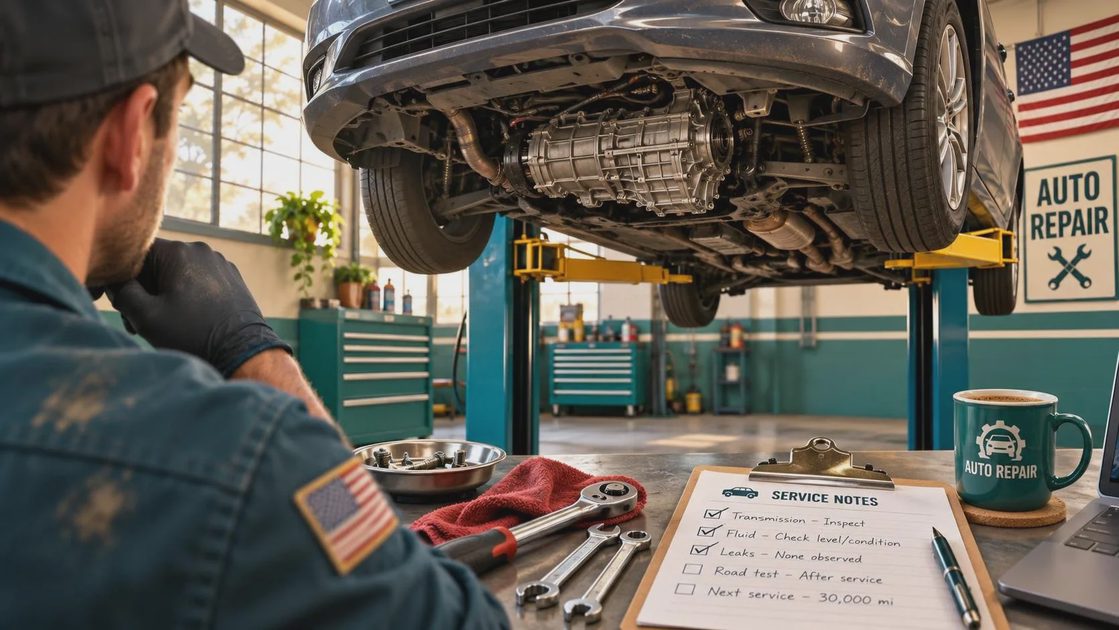
Whats transmission in a car compared with an EV drivetrain
Electric vehicles change the answer substantially. Most battery-electric cars use a single-speed reduction gear instead of a multi-speed transmission. An electric motor produces useful torque from zero rpm, so it does not need the same series of ratios as a gasoline engine. This simpler arrangement has fewer moving parts and usually removes the need for conventional transmission fluid changes.
That does not mean an EV has no drivetrain hardware. It still has a reduction gear, bearings, differential components, shafts, software, and cooling systems. The power electronics control motor speed and torque, while regenerative braking sends some energy back to the battery. Models such as the Tesla Model 3, Hyundai Ioniq 5, and Rivian R1T demonstrate how a one-speed setup can provide immediate acceleration without gear changes.
A small number of EVs use more than one ratio for performance or efficiency. The Porsche Taycan, for example, uses a two-speed rear-axle transmission. That design is an exception rather than the industry baseline. On a simple comparison chart, a conventional gas vehicle may have hundreds of transmission-related moving components, while a typical single-speed EV drivetrain has a much shorter mechanical path. Exact component counts are not standardized, so treat that comparison as a design observation, not a published statistic.
What failure feels like and what repairs cost
The clearest warning signs include delayed engagement, slipping, harsh shifts, grinding, shuddering, leaking red or dark fluid, and an engine that revs without a matching increase in speed. A dashboard warning light does not identify the failed part by itself. A technician needs diagnostic codes, fluid inspection, a road test, and sometimes pressure testing.
Repair pricing varies by vehicle, region, and failure. A fluid service can often land around $150 to $400. A solenoid, sensor, or valve-body repair may run roughly $500 to $2,000. Rebuilding a conventional transmission commonly reaches $2,500 to $5,000, while replacement with a new or remanufactured unit can exceed $4,000 and reach $8,000 or more on luxury, performance, or four-wheel-drive vehicles. These are planning ranges, not quotes; my estimates assume typical U.S. shop labor and exclude unusual damage.
The number that matters is not just the repair invoice. It is repair cost divided by the vehicle's realistic market value. Spending $5,000 on a reliable $25,000 car may be rational. Spending the same amount on a rusty 15-year-old car worth $7,000 requires a harder look at tires, suspension, cooling, and electrical work that could arrive next.

How transmission choice affects buying and insurance
Before buying, request maintenance records and identify the exact transmission code or configuration. A model name is not enough because the same vehicle can use different transmissions by engine, trim, year, or drivetrain. Search owner-service documentation for fluid specifications and intervals. A seller who says the fluid is “lifetime” still may not have a documented service history; lifetime describes the manufacturer's maintenance schedule, not an unlimited mechanical lifespan.
For a used test drive, begin with a cold start. Confirm that reverse and drive engage without a long pause. Accelerate gently, then firmly, and watch for flare, vibration, or a sharp bang during shifts. Drive uphill, reverse into a parking space, and check underneath after the drive for fresh fluid. Paying $150 to $250 for a pre-purchase inspection is cheap compared with discovering a $4,000 drivetrain problem after purchase.
Transmission type can influence insurance indirectly. Insurers price risk using factors such as vehicle value, theft history, repair cost, driver profile, location, and coverage limits. A complex luxury transmission can raise collision claim severity because parts and labor cost more, but no universal surcharge applies simply because a car has a CVT or manual gearbox. Compare quotes using the exact vehicle identification number when possible.
If a lender requires full coverage, collision pays for covered damage to your vehicle after a crash, subject to your deductible. Comprehensive coverage addresses non-collision losses such as theft, hail, or flooding; it does not normally pay for mechanical wear or an internal transmission failure. An extended service contract is a separate product and may cover specific drivetrain failures, exclusions, and diagnostic fees.
The spreadsheet decision
I score transmission choices on four factors: efficiency, response, service complexity, and downside cost. A modern automatic usually scores well for smoothness and broad availability. A manual can score well for driver engagement and simpler mechanical control. A CVT can score strongly for efficiency if the specific model has a solid service record. A single-speed EV drivetrain wins on mechanical simplicity, but battery condition and software support become larger ownership questions.
By the Numbers: budget $200 for an inspection, keep a repair reserve of at least $2,000 for an older gas vehicle, and compare at least three insurance quotes before signing. Those figures are practical planning targets, not guarantees. The strongest purchase is the one whose transmission design, service history, repair reserve, and insurance premium fit the same monthly budget.
So, whats transmission in a car? It is the power-management system that turns engine or motor output into usable wheel speed. Understand the design before you focus on horsepower, and you will make a better comparison. Get the vehicle history, test the drivetrain cold and hot, obtain an inspection, then quote insurance with the correct trim. That process takes an afternoon and can prevent one of the most expensive surprises in used-car ownership.
No comments yet.