A large pickup truck is no longer a simple choice between a V8 and a bigger V8. Today, the shortlist includes turbocharged gas engines, hybrid powertrains, diesel heavy-duty models, and electric trucks with instant torque. The useful question is not which truck has the largest advertised number. It is which vehicle matches your actual miles, payload, towing schedule, parking situation, and budget.
I score trucks on five categories: capability, efficiency, comfort, technology, and ownership cost. That framework exposes a common mistake: buying maximum capacity when you only need a comfortable commuter with occasional weekend utility. The extra $8,000 to $20,000 for a larger engine or heavy-duty chassis can be difficult to justify if your trailer weighs 5,000 pounds and your work commute is 30 miles.
What counts as a large pickup truck?
In practical shopping terms, a large pickup truck usually means a full-size pickup, not a midsize model such as the Ford Ranger, Toyota Tacoma, or Chevrolet Colorado. The core group includes the Ford F-150, Chevrolet Silverado 1500, GMC Sierra 1500, Ram 1500, and Toyota Tundra. Heavy-duty versions such as the Ford Super Duty, Chevrolet Silverado HD, GMC Sierra HD, and Ram HD sit one class higher in towing and payload.
Dimensions vary by cab, bed, and drivetrain, but a crew-cab full-size pickup can easily stretch beyond 19 feet. That matters in a downtown garage or a narrow suburban driveway. A short-bed configuration is easier to live with, while a long bed gives contractors and serious haulers more useful cargo space. Measure your parking space before you fall in love with a specification sheet.
The key distinction is rated capacity. Towing is the trailer weight a properly equipped truck can pull. Payload is the weight of passengers, cargo, and trailer tongue weight carried by the truck itself. A truck with a 12,000-pound tow rating can still be overloaded by four adults, a toolbox, camping equipment, and a heavy trailer tongue.
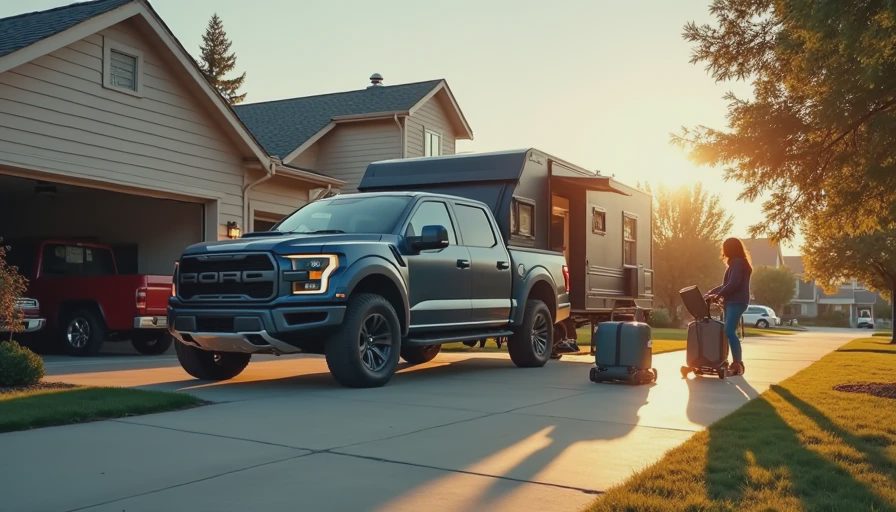
By the Numbers: gas, hybrid, diesel, or electric
A half-ton gas truck remains the default because it balances price, range, service access, and towing. Ford, Chevrolet, GMC, Ram, and Toyota all offer configurations with published maximum tow ratings above 12,000 pounds, though those figures require specific engines, axle ratios, cab styles, and equipment. The base truck and the maximum-rated truck are not the same product.
Hybrid systems are more interesting than their fuel-savings headlines suggest. Ford's F-150 PowerBoost combines a turbocharged engine with an electric motor and can provide useful onboard power for tools, tailgates, or emergency backup. The benefit is strongest for drivers who spend time in traffic or need electrical output at a job site. It is not automatically the cheapest option after purchase price and financing are included.
Diesel still makes sense for frequent heavy towing. A diesel HD large pickup truck generally offers strong low-speed torque and better efficiency under load, but the purchase premium, diesel exhaust fluid, maintenance, and heavier chassis reduce its appeal as a commuter. If you tow a large enclosed trailer twice a year, renting a diesel may be cheaper than owning one for 365 days.
Electric trucks change the calculation. The Ford F-150 Lightning, Chevrolet Silverado EV, GMC Sierra EV, and Rivian R1T offer quiet operation, rapid acceleration, and home-charging convenience. Towing can reduce driving range substantially, and charging with a trailer attached is not equally convenient at every station. For a driver towing locally, an EV can be excellent. For long-distance towing across rural routes, a gas or diesel truck remains easier to plan.
Match the truck to the job, not the fantasy
Start with your heaviest real load from the last 12 months. Write down the trailer's loaded weight, not its empty weight. Add passengers, fuel, tools, bikes, and cargo. Then compare that total with the truck's door-jamb payload label and tow guide. This five-minute exercise is more valuable than watching another launch video.
A driver hauling mulch, furniture, or a small utility trailer may need bed space and a strong payload rating rather than extreme tow capacity. A boat owner should focus on tongue weight, launch-ramp traction, wheelbase, and corrosion protection. A contractor may value a 6.5-foot bed, a 120-volt outlet, a locking storage system, and a dealer network more than leather seats.
For city and suburban use, test the turning circle, hood visibility, parking sensors, camera quality, and step-in height. A large pickup truck that barely fits your garage is not practical transportation. I also recommend measuring the rear seat with a child seat, work backpack, or folded bicycle in place. Crew-cab comfort is a major reason buyers accept the size penalty, so make sure the cabin earns it.
Total cost: the purchase price is only the first line
New full-size pickups commonly span roughly $40,000 to well above $80,000 depending on trim, incentives, powertrain, and options. Heavy-duty and luxury configurations can pass $90,000. These are broad market ranges, not a quote; dealer pricing changes quickly, and advertised prices often exclude taxes, registration, destination charges, and accessories.
Fuel is the easiest cost to model. Multiply your annual miles by the truck's real-world gallons per mile, then multiply by your local fuel price. Use a conservative estimate rather than the best EPA figure. A driver covering 15,000 miles in a truck averaging 18 mpg uses about 833 gallons annually. At $3.50 per gallon, that is about $2,916 in fuel. A truck averaging 24 mpg would use about 625 gallons, or roughly $2,188 at the same price.
Insurance is another meaningful line item. A large pickup truck can cost more to insure because replacement parts, repair complexity, theft risk, and vehicle value all affect premiums. Comprehensive and collision coverage are especially relevant on a newer, expensive truck. Get quotes using the exact VIN or trim before signing a purchase agreement; the difference between a basic work trim and a high-output luxury version can be significant.
The technology scorecard
Modern trucks are rolling software platforms, but the feature list needs a reality check. Adaptive cruise control, a 360-degree camera, blind-spot monitoring that covers the trailer, and wireless smartphone integration improve daily use. A built-in generator or large inverter can be genuinely useful. A giant screen is less valuable if menus are slow or physical climate controls are missing.
Check payload and towing information in the instrument display during a test drive. Some trucks offer trailer profiles, tire-pressure monitoring, trailer-light checks, and route planning. These features reduce friction, but they cannot compensate for an overloaded hitch or an unsuitable tire. I prefer a truck with clear gauges and dependable controls over one with a more impressive-looking interface.
For electric models, compare usable battery capacity, charging speed, home electrical requirements, and cold-weather performance. Ask whether your apartment, workplace, or home can support charging. An EV that begins each morning full can be cheaper and calmer than a gas truck, but public charging becomes a planning issue when a trailer blocks neighboring spaces.
My buying rubric and bottom line
On the CaliperScore rubric, a sensible large pickup truck earns points for capability you will use, not capacity you can mention at a barbecue. Start with a half-ton crew cab if your trailer is below its comfortable rating and daily driving matters. Choose a hybrid when onboard power and stop-and-go efficiency have clear value. Choose an HD diesel when heavy towing is routine, not hypothetical. Choose electric when home charging and local or regional towing fit your schedule.
Before buying, price three configurations: the efficient mid-trim, the properly equipped towing trim, and the EV or hybrid alternative. Compare monthly payment, insurance, fuel or charging cost, tires, and service over five years. Then drive each route you actually use, including a parking garage and a highway merge. The best large pickup truck is not the one with the biggest grille or the highest number in a brochure. It is the one that solves your weekly jobs without charging you for capability that sits unused.
No comments yet.