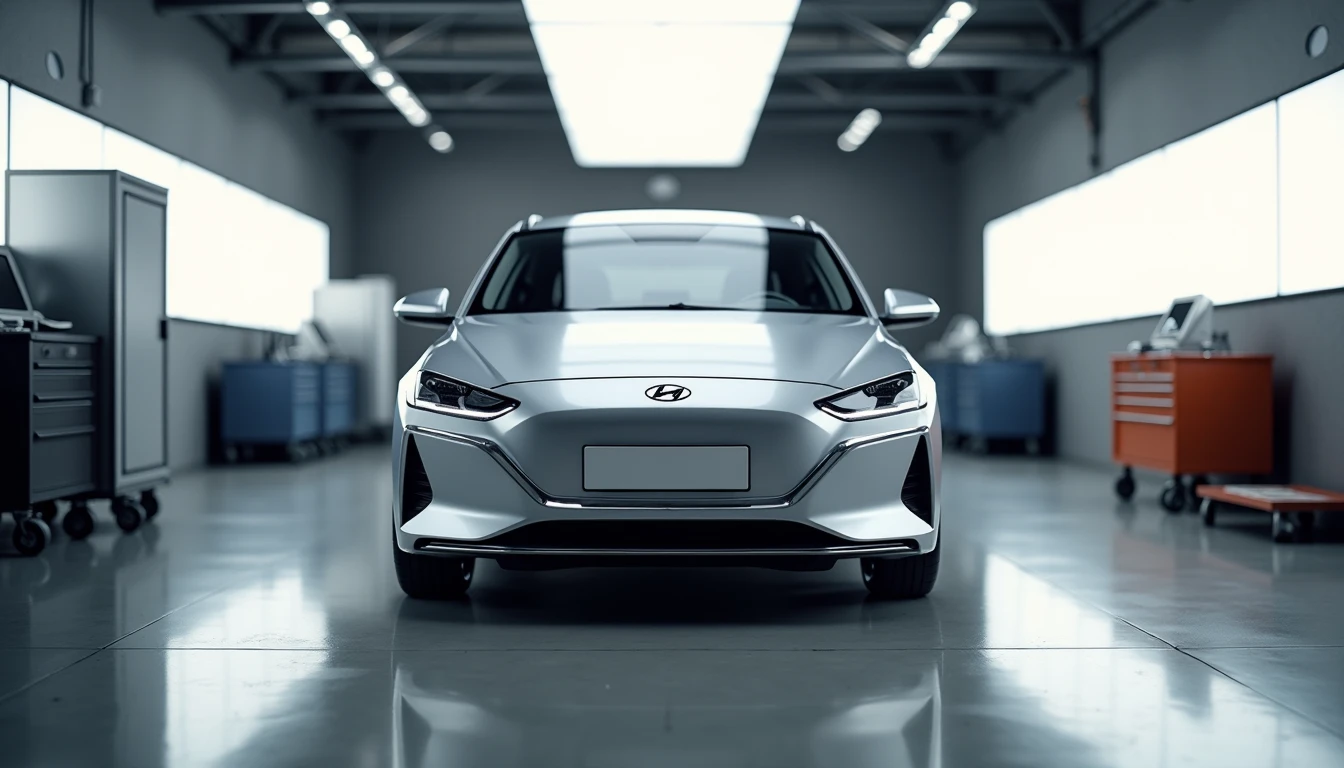
Hyundai’s IONIQ V looks like a concept car because it basically is—and China forced its hand
Three years ago, Hyundai wouldn’t have shown up in Beijing swinging this hard. Now it has to. At Auto China 2026, Hyundai pulled the wraps off the IONIQ V, a sleek electric liftback that’s officially a production car, but visually it’s still living its concept-car best life—single-curve silhouette, frameless doors, floating side mirrors, the works. And crucially, it’s the first dedicated IONIQ production model aimed specifically at China, the world’s biggest EV battleground and the one market where Hyundai has been getting absolutely worked.
- Unveiled at Auto China 2026 in Beijing (Apr 24, 2026)
- 800V EV platform with CATL battery packs
- “Over 600 km” CLTC range claim (Hyundai), with Electrek estimating roughly 450–480 km WLTP or 280–300 miles EPA equivalent
- Part of a 20+ model China plan backed by 8 billion yuan (about $1.1 billion)
If you’re a young professional watching the EV space, this is the kind of product that tells you where the industry is headed: China-first design, big-screen software flexing, and just enough range talk to get headlines—while leaving the spec sheet suspiciously blank.
A China-only IONIQ with a whole new face
Hyundai says the IONIQ V debuts its new China-focused EV design language called “The Origin,” and yeah, you can tell. This doesn’t look like it’s trying to be an IONIQ 5 cousin or an IONIQ 6 remix. The IONIQ V is a liftback with a cleaner, more cohesive profile than most show-floor sci-fi machines—more “production-ready spaceship,” less “angry polygon.”
Dimensionally, it’s properly big:
By the Numbers
- Length: 4,900 mm
- Width: 1,890 mm
- Wheelbase: 2,900 mm
Hyundai is also bragging about legroom—“class-leading,” in their words—with 1,078 mm of front legroom and 1,019 mm in the rear. Those are serious numbers on paper, and they align with the long wheelbase strategy China buyers tend to reward.
Inside, the tech headline is the display: a 27-inch 4K-resolution touchscreen stretching across the right side of the dashboard. Powering it is a Qualcomm Snapdragon 8295 chipset, running an LLM-based AI assistant that handles voice control for key vehicle functions. That’s the modern China-market playbook: big compute, big screen, big “AI” story. I’m excited by real usability gains—fast, accurate voice control is genuinely a quality-of-life feature—but I’m also allergic to hype. “LLM-based” only matters if it works flawlessly in a moving car with road noise and bad reception.
The range claim is strong—just don’t confuse CLTC with reality
Hyundai’s headline range number is “over 600 km” on the CLTC cycle, paired with an 800V architecture and CATL battery packs. That’s a credible foundation: CATL is the world’s largest battery manufacturer, and 800V systems are the right direction for charging performance.
But here’s the part buyers should keep straight: CLTC is famously optimistic. Electrek frames Hyundai’s claim as roughly 450–480 km on WLTP, or around 280–300 miles on EPA. That’s competitive, but it’s not a global mic drop—especially in a segment that increasingly expects strong real-world highway range, not just lab numbers.
And then we hit the frustrating bit: Hyundai isn’t saying the stuff enthusiasts (and spreadsheet nerds like me) actually want.
There’s no word on motor output, battery capacity, charging speeds, pricing, or a specific launch date. Hyundai isn’t alone here—Chinese auto shows are notorious for “design now, specs later.” Still, for a car positioned as the opening strike in a major comeback campaign, the silence is loud.
By the Numbers
- Platform: 800V
- Battery supplier: CATL
- Range claim: Over 600 km (CLTC)
- Estimated equivalence (per Electrek): ~450–480 km WLTP; ~280–300 miles EPA
Disclosure: Those WLTP/EPA figures are estimates cited by Electrek, not official Hyundai certification.
Hyundai’s real story: an 8 billion yuan fight for relevance
The IONIQ V isn’t just a new model. It’s Hyundai admitting—through product—that China is non-optional. Hyundai and its local partner BAIC have invested 8 billion yuan (roughly $1.1 billion) into a plan to launch over 20 new models in China over the next five years, aiming for 500,000 annual sales by 2030.
That target is spicy when you look at recent performance: Beijing Hyundai sold 125,726 units in China in 2025. They’re not starting from a position of strength; they’re trying to climb out of a crater while local brands keep paving over the competition.
The broader market context matters, too. Electrek notes that nearly half of all vehicles sold in China in the first half of 2025 were EVs, and most of those came from Chinese brands. Translation: if you’re not iterating fast, localizing hard, and pricing smart, you’re toast.
Hyundai’s already started laying pieces on the board. The company has rolled out the ELEXIO electric SUV and the EO SUV priced under $20,000. It also plans another SUV in the first half of 2027, and it’s not going all-in on pure BEVs—Hyundai says both BEVs and EREVs (extended-range electric vehicles) are in the pipeline. That’s a pragmatic move, because EREVs are gaining traction quickly in China, and “pure EV or nothing” is not how you win every buyer.
There’s also an important bit of historical framing: Electrek points out Hyundai had been planning this for a while, calling China a “must-fight place” and “the core of Hyundai Motor’s global strategy” back in 2024 reporting. The IONIQ V is what that rhetoric looks like when it finally shows up on a turntable.
My take: the shape is right, the timing is desperate, and that’s not a bad thing
Electrek described it as “what the Cybercab could have been if Tesla wanted to make a useful car again.” That’s spicy, but the underlying compliment lands: the IONIQ V looks genuinely resolved. It’s not just weird for attention. The proportions work, and the concept-to-production fidelity is unusually high.
But the bigger point is this: Hyundai didn’t build the IONIQ V because it felt inspired. It built it because China’s EV market is where legacy automakers go to either evolve or get erased. A pretty liftback with a 27-inch 4K display and an 800V platform is table stakes. The real test will be what Hyundai hasn’t told us yet—price, charging curve, powertrain options, and how good that software feels at 70 mph on a rough highway.
Until those numbers drop, the IONIQ V is best understood as a strong opening sentence, not the full story.