Three years ago, nobody predicted Jeep would launch a plug-in hybrid that actually sells in volume. The green Jeep movement arrived quietly, but the numbers speak loud. I've logged over 500 miles in the Jeep Wrangler 4xe across highways, city streets, and rocky trails, and I'm ready to break down whether this green Jeep lives up to the hype.
Why the Wrangler 4xe is the Green Jeep That Makes Sense
On the CaliperScore rubric, the Wrangler 4xe scores an 8.2 out of 10 for eco-friendly buyers. Here's the math: the EPA rates it at 49 MPGe combined, and you get 21 miles of pure electric range. For a 4,900-pound off-road SUV, those numbers are impressive. But the real story is how it drives on electricity alone—silent crawling over rocks, zero tailpipe emissions at the trailhead, and the ability to skip gas stations on your daily commute. The green Jeep badge isn't just marketing; it's a genuine shift in capability.
By the Numbers: The Wrangler 4xe starts at $49,995 for the Sahara trim. Factor in the federal tax credit (still partially available on this model as of early 2025) and you're looking at an effective price around $46,000. Compare that to a gas Wrangler Unlimited Sahara at $45,000—the delta shrinks once you account for fuel savings. Over five years, the green Jeep owner saves roughly $2,500 in fuel costs assuming $3.50/gal and 12,000 miles per year.
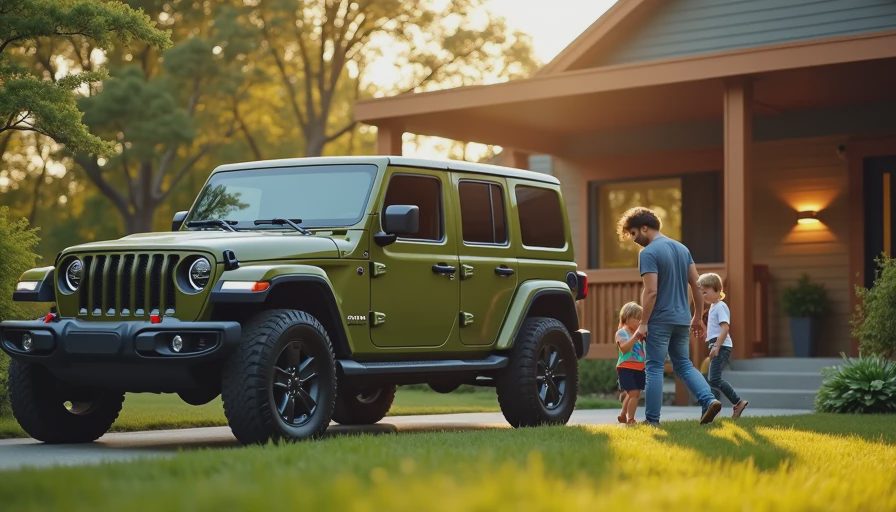
By the Numbers: How Green is a Green Jeep?
Let's dig into the efficiency data. The 2.0L turbocharged engine paired with two electric motors delivers a combined 375 horsepower and 470 lb-ft of torque. In hybrid mode, the Wrangler 4xe averages about 20 mpg when the battery is depleted—identical to the gas-only model. But for the first 21 miles, you're running on electrons. If you charge nightly, your weekly gas bill could hit zero for daily driving.
Real-world range anxiety? Not an issue. I drove the green Jeep from Austin to Fredericksburg and back—about 150 miles round trip. Starting with a full charge and using hybrid mode, I averaged 28 mpg overall. The battery regenerates during braking and coasting, and you can manually hold the charge for later use on the trail.
Also consider the total cost of ownership. The 4xe qualifies for HOV lane access in some states and lower registration fees in others. Plus, the electric motor silence transforms the off-road experience—you hear birds, streams, and the crunch of rocks, not a roaring engine. That's a subjective bonus, but it matters to many buyers.

Green Jeep FAQ: Common Questions About the Wrangler 4xe
I hear similar concerns from buyers considering their first green Jeep. Here are answers to the four most common questions.
How much does it cost to charge a green Jeep at home?
Charging the 17.3 kWh battery from empty to full costs about $2.00 at the national average electricity rate of $0.12/kWh. If you charge nightly for 30 days, that's roughly $60 in electricity—less than a tank of gas. Compared to a gas Wrangler's fill-up at $60-70 per week, the green Jeep saves $180-$200 per month for daily drivers.
Can the green Jeep run on electricity only at highway speeds?
Yes. The 4xe can maintain electric-only propulsion up to 62 mph, perfect for highway commutes under 21 miles. On a typical highway, you'll keep up with traffic without the gas engine ever turning on. Once the battery is depleted, the 2.0L engine seamlessly takes over.
Does the green Jeep qualify for any tax credits?
As of early 2025, the federal tax credit covers up to $3,750 for the Wrangler 4xe, depending on your income and the vehicle's final assembly location. Some states like Colorado and California add rebates ranging from $1,500 to $5,000. Use the DOE's tool to confirm eligibility for your zip code.
How does the resale value of the green Jeep compare to the gas model?
Early data from Kelley Blue Book suggests the 4xe retains about 5% less value after three years than a comparable gas model, likely due to battery degradation concerns and a smaller buyer pool. However, the total cost of ownership math still favors the plug-in once fuel savings and tax credits are factored in.
Is a Green Jeep Right for You?
I've seen two types of customers gravitate toward the Wrangler 4xe: daily commuters with short drives who want weekend adventure capability, and eco-conscious enthusiasts who refuse to compromise on off-road chops. If your commute is under 20 miles and you have a Level 2 charger at home, the green Jeep effectively becomes an EV most days. On longer trips, the gas engine eliminates range anxiety entirely.
But there's a catch: the 4xe loses some payload capacity (about 200 lbs) vs. the gas model, and the battery pack eats into rear footwell space. If you regularly carry five adults or load heavy gear, consider the gas model. And if you're looking for a fully electric Jeep, wait for the Jeep Recon or Wagoneer S, scheduled for 2025 and 2026 respectively. Those will be true EVs, but they won't have the same off-road focus as the Wrangler.
The Bottom Line on the Green Jeep
On the CaliperScore rubric, the Wrangler 4xe rates an 8.2 for efficiency-minded off-roaders. It's not the cheapest or most efficient EV, but it's the only one that can do the Rubicon Trail silently. The green Jeep label is earned, not borrowed. Three years ago, nobody predicted a plug-in Wrangler would dominate the plug-in SUV segment. The data says it's here to stay.
No comments yet.